
Due dates and withdrawals, handled for you.
Two pieces of arithmetic decide whether a season goes well: when she's due, and when he can be sold. Both are easy to get wrong on paper and both are automatic here.
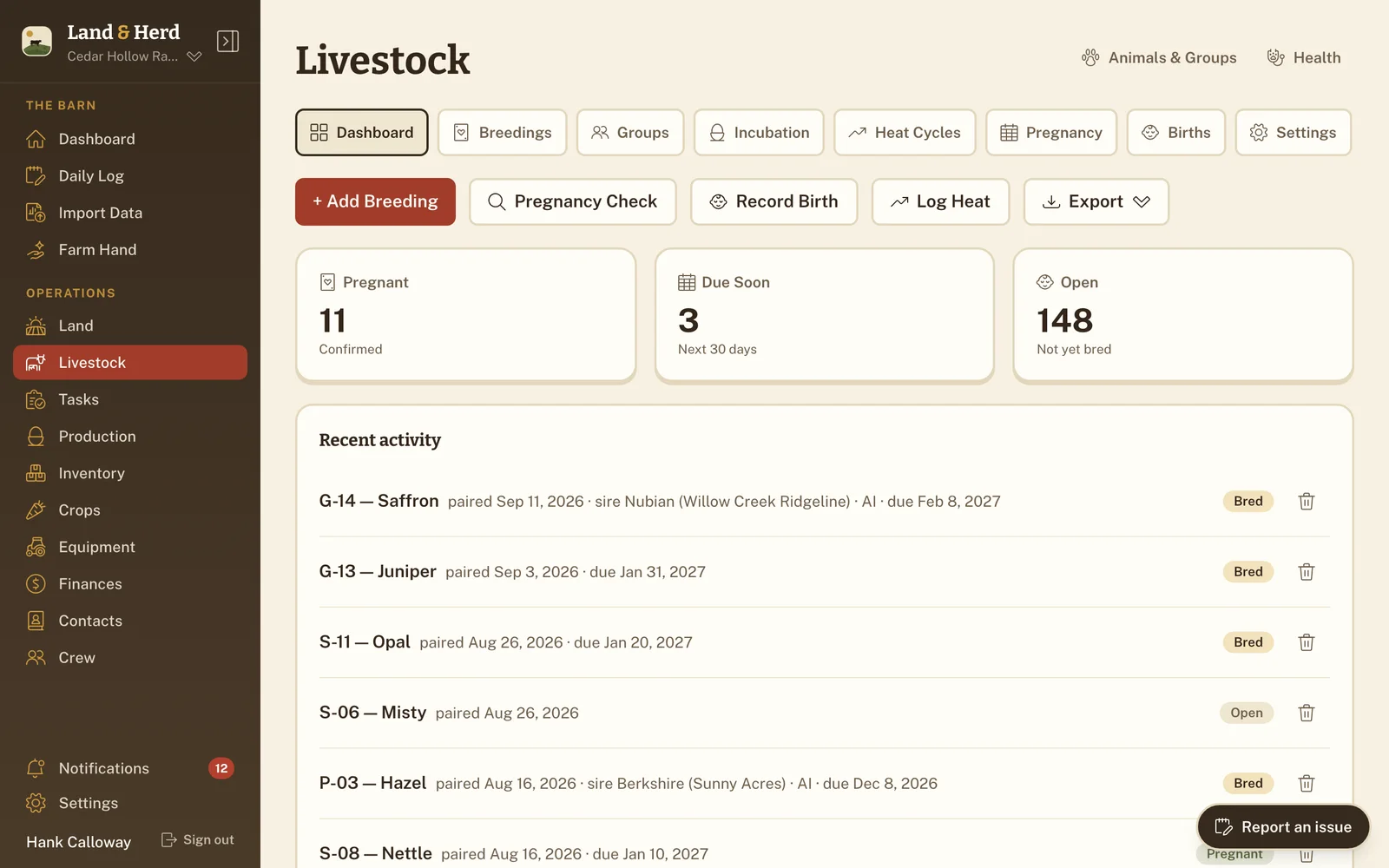
Log the breeding, get the date
Record a breeding — natural or A.I. — and Land & Herd works out the due date from that breed's own gestation (how long a pregnancy runs) length, not a rounded figure for the species. Angus run 281 days, Hereford 285, Charolais 287; a cow bred today isn't due on the same day a doe bred today is, and you shouldn't have to hold any of it in your head.
Three numbers can answer that question — one you've set for the species yourself, the breed's, and the species default — and they're tried in that order. The app tells you which one it used, because a breeder who disagrees with a date needs to know whether to correct their own setting or the animal's breed.
From there every female sits in one of three states you can see at a glance — Pregnant, Due Soon, or Open — so "who's calving this month" is a look, not a calculation. Heat cycles and pregnancy checks go on the same record, and when the birth happens you log it there too: the offspring links back to the breeding it came from, and forward into the herd as its own animal.
A bull in with the heifers isn't a single breeding
Most stock aren't bred one at a time. Put a sire (father) in with a set of females for a season and that's a breeding group: the females go in as exposed, and each one moves to checked pregnant, open, recheck or delivered as you work them. Close the group when the season's over. It's the shape pasture breeding actually has, rather than forty breeding records invented after the fact.
Eggs, from set to hatch
Poultry and waterfowl don't gestate, they incubate — so they get their own tab. Set a batch, record the candling along the way, log the hatch when it comes, and the batch closes with what actually came out of it. If your operation is ducks and quail rather than cows, this is the part of breeding you'll live in.
Births, recorded as they actually went
A birth isn't only a date. You log how it went — unassisted, easy assist, difficult, or surgical — and that stays on the dam (mother)'s record, because a cow that needed help twice is telling you something about next season. Later the offspring gets a weaning outcome — weaned, sold, retained, or died — so the season closes with a real number rather than a guess at how many made it.
Withdrawal tracking, because the deadline is real
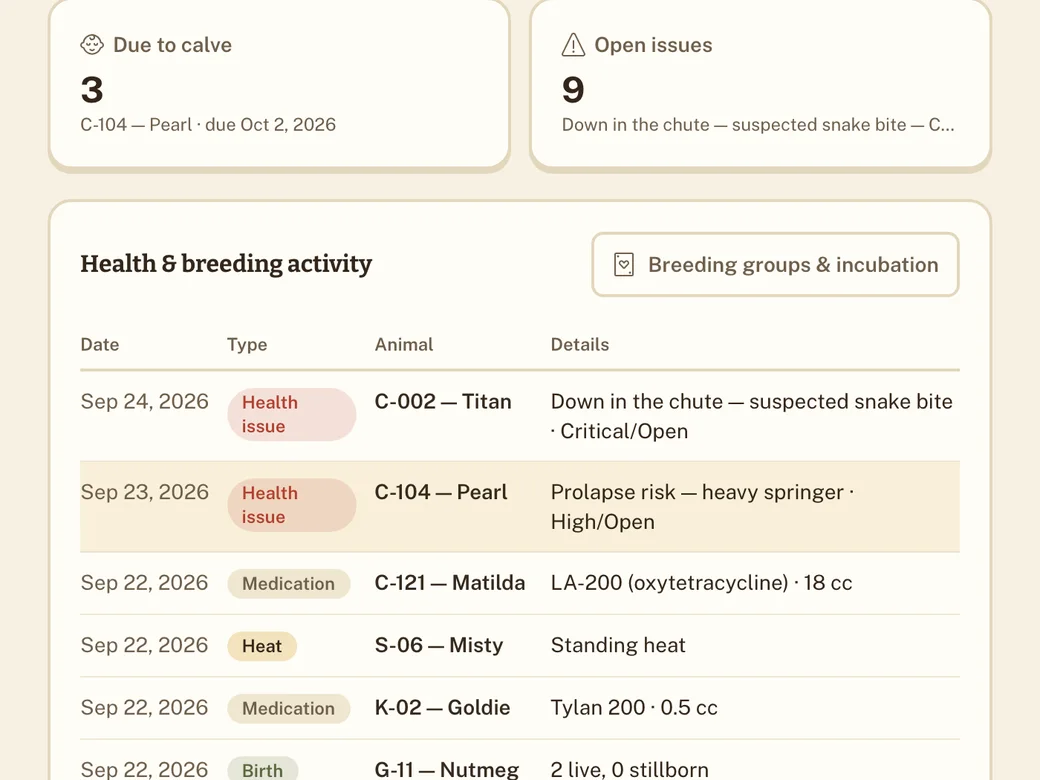
When you log a medication, you log its withdrawal (the days after a treatment before milk or meat can be sold) period with it. From that moment the animal is flagged, the dashboard's Attention Needed feed knows about it, and a livestock filter will pull up everything currently under withdrawal.
This is the one number on the place where a mistake costs real money and real trust, and it's the number most likely to be living in someone's head or on the back of a feed bag. Here it lives on the animal.
Health that reads like a history, not a form
- Issues with severity and status — what's wrong, how bad, and whether it's still open.
- A medication log per animal, with the withdrawal clock attached to each entry.
- Batch treatment for a whole group, so worming a flock is one action rather than thirty.
- Quick check-ins for the days when you just want to note that you looked and she's fine.
The numbers that tell you it's working
Metrics go on the animal alongside everything else: weights over time, FAMACHA (the eyelid-colour check for worms) scores for the small ruminant people watching barber pole worm, feed conversion, and parasite checks. Recorded as you go, they turn into the history you need when you're deciding what to keep and what to cull (removing an animal from the herd) — instead of a gut feeling about which ewe "seems to do well."
The health picture for the whole herd
What this connects to
Livestock
The animal records all of this hangs off — tag, breed, herd, pasture and ancestry.
Livestock management →Tasks
"Call the vet about Duke's leg" belongs on a list someone will actually see, with a due date and a name against it.
Tasks & daily log →Goats & sheep
FAMACHA scoring, kidding and lambing dates, and flock-level treatment in one place.
For goat & sheep farms →Stop doing gestation math on a feed bag
Set up your ranch in a couple of minutes. Log one breeding and one treatment, and let the app carry both dates from there.