
Built for how small ruminants actually get managed.
Goats and sheep aren't small cattle. The record keeping that matters is different — parasite pressure, kidding and lambing bunched into a few weeks, treatment at flock level, and milk measured every single day.
FAMACHA scores as a first-class number
If you're running small ruminants on pasture, barber pole worm is the thing that keeps you up. FAMACHA (the eyelid-colour check for worms) scores are one of the metrics recorded against an animal — not a note in a comments field — alongside weights, parasite checks and feed conversion.
Which means the score is a history rather than a moment. The ewe who has needed treating three times this year looks different from the one who never has, and by selection season the difference is written down.
Kidding and lambing, dated properly
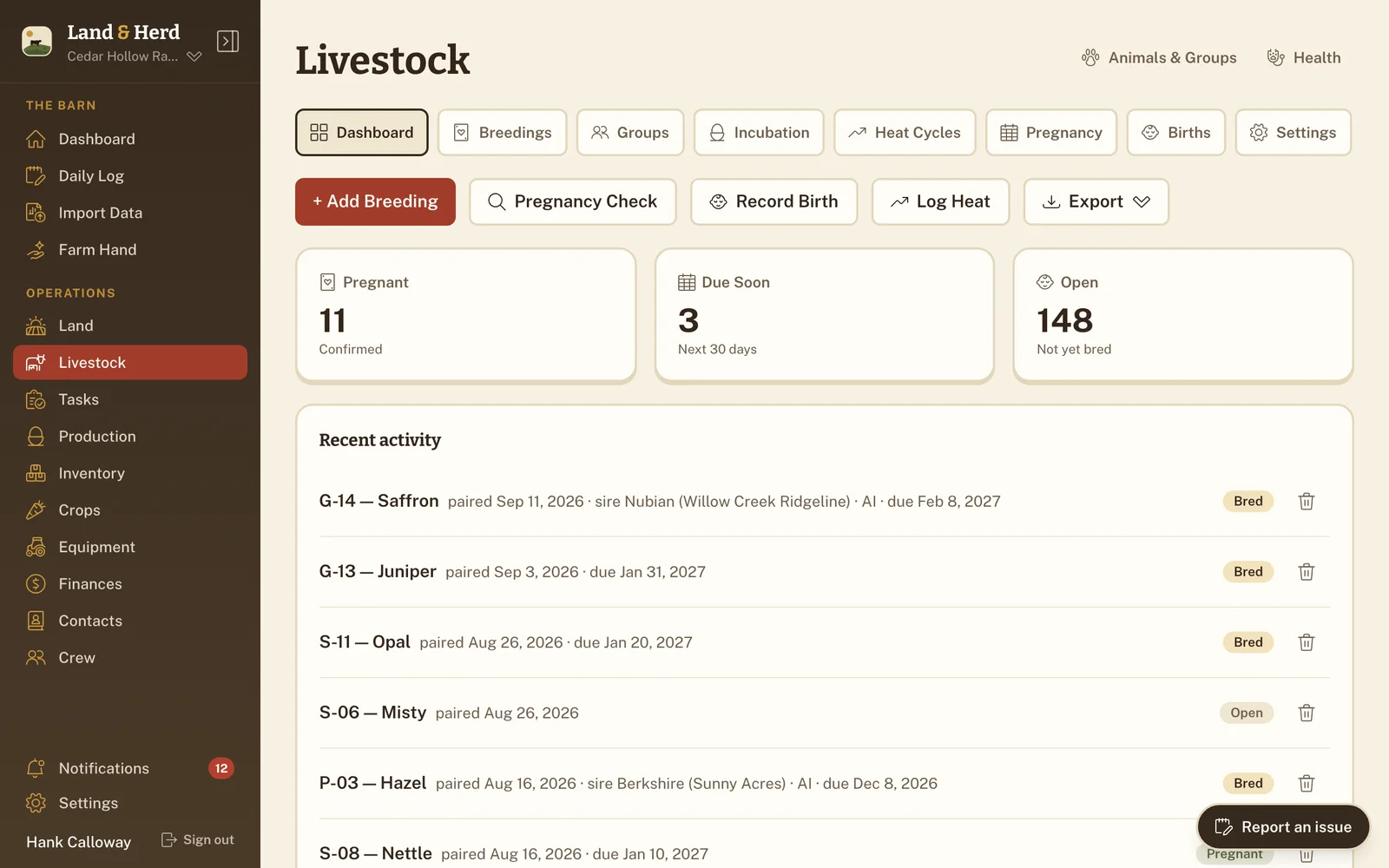
Log a breeding and the due date comes from that breed's own gestation (how long a pregnancy runs), falling back to the species — 150 days for goats, 147 for sheep by default, both adjustable to your own numbers. Heat cycles and pregnancy checks go on the same record, and when kids or lambs arrive you log the birth there too, with the offspring linked back to the breeding and to their dam (mother).
With a whole flock bred inside a couple of weeks, "who's due when" stops being something anyone can hold in their head. Pregnant, Due Soon and Open at a glance is the difference between a planned kidding barn and a surprise.
Treat the flock, not thirty individuals
Worming the flock shouldn't be thirty trips through a form. Batch treatment applies a medication to a whole group in one action — and the withdrawal (the days after a treatment before milk or meat can be sold) clock lands on every animal it touched, so nobody's milk or meat goes anywhere it shouldn't.
- Withdrawal tracking on every treated animal, individually or in a batch.
- Flocks as groups that move between pastures together.
- Issues with severity and status, so what's open stays visible.
- Metrics over time — FAMACHA, weight, parasite checks, feed conversion.
Milk logged daily, priced automatically
Define your own production types with a unit and a per-unit value — goat milk by the gallon, cheese by the pound, whatever you sell — and log them as you go. Every entry is priced for you, so at the end of a season you have what the dairy actually produced and what it was worth, not an estimate.
And rotation, because parasites live in the grass
The other half of parasite management is not going back too soon. Give each paddock (a fenced grazing section) a rest period, log a graze, and let the countdown tell you when it's ready — with the ready alert surfacing on your dashboard. More on rotational grazing →
The parts a small-ruminant operation leans on
Breeding & health
Due dates, batch treatment, withdrawal tracking and FAMACHA scoring.
Breeding & health →Production
Milk by the gallon, priced per unit, logged the day it happened.
Production & inventory →Pastures
Rest periods that give the grass — and the parasite load — time to clear.
Rotational grazing →Get the flock's records off the clipboard
Set up your farm in a couple of minutes and bring the records you already keep. Put the flock in and let the kidding dates, FAMACHA scores and milk records run from there.