
Every animal, individually tracked.
A row in a spreadsheet tells you an animal exists. A record in Land & Herd tells you who her mother was, what she was treated with, when she's due, which pasture she's standing in, and whether she can go to the sale barn this week.
29 species, each on its own terms
A ewe isn't a heifer (a young cow that hasn't calved yet) and a laying hen isn't either. Land & Herd starts with cattle, horses, goats, sheep, pigs, chickens and rabbits, then keeps going: ducks, geese, turkeys, quail, guinea fowl, pheasant, peafowl and pigeon; ostrich and emu; alpaca, llama, donkey and mule; bison, yak, water buffalo and deer; honey bees; and the guardian dogs and barn cats that work the place. Each brings its own breed list, its own sex classifications, and its own gestation (how long a pregnancy runs) or incubation length for working out due dates — and if what you keep still isn't on the list, you add the species yourself and it behaves like the rest.
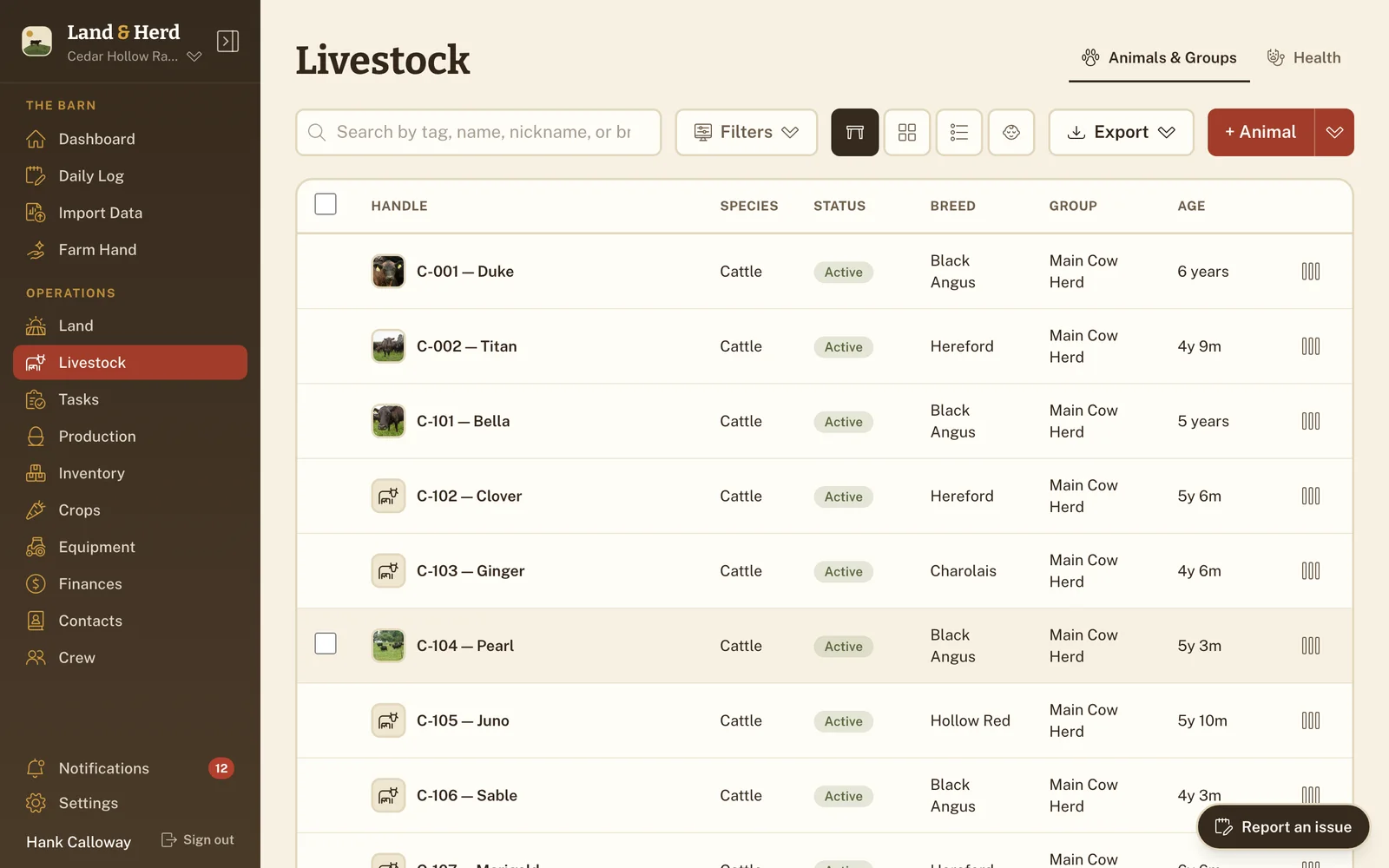
Every head gets a record: tag, name, registration number and EID (electronic ear tag), breed, birth date, classification, the herd or flock it belongs to, and the pasture it's standing in. Registered stock carry their papers in the same place as everything else, and both fields come out on the animal's printed record. You can look at them as a table when you want density, a grid when you want faces, or a list when you're on a phone in the barn.
Ancestry that actually links up
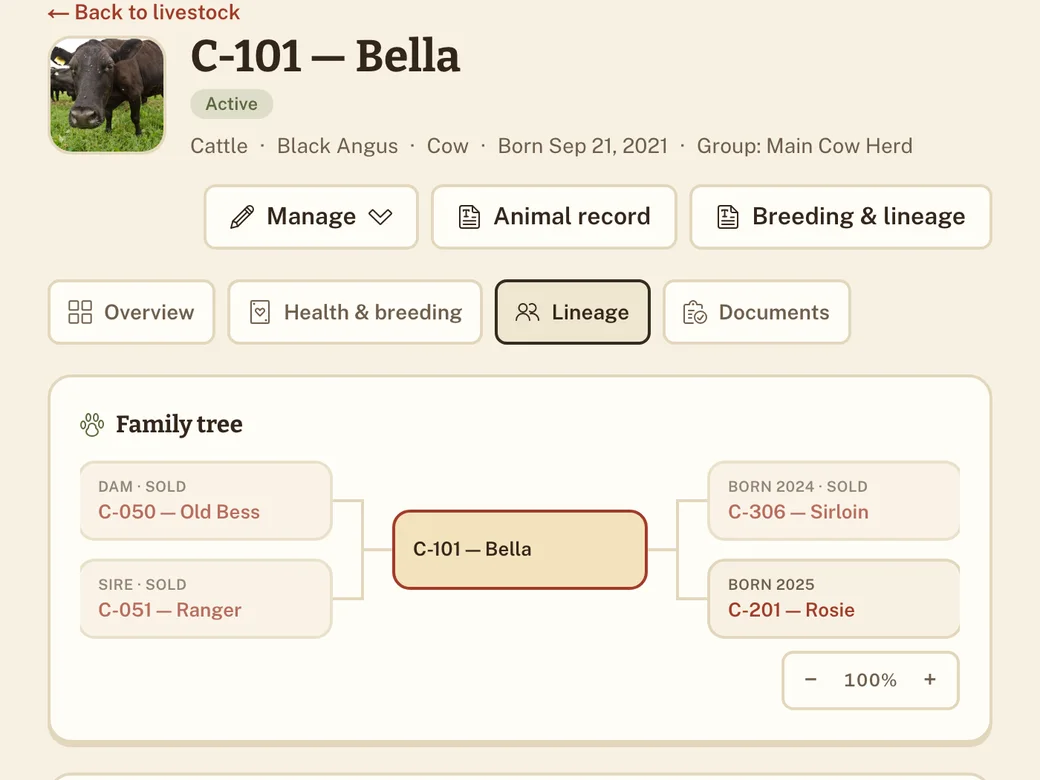
Dam and sire (father) aren't free-text fields — they point at other animals in your herd. Open a cow and you can walk to her mother, or down to the two calves she's thrown. When you record a birth, the offspring is linked to the breeding it came from automatically, so the family tree builds itself as the season goes on rather than as a data-entry chore in January.
Herds and flocks, moved together
Animals group into herds and flocks, and groups move as a unit. When the main cow herd goes from Creek Bottom to East Meadow, that's one action, not forty. The pasture each animal is standing in stays current without anyone editing forty records — which is exactly why it stays accurate.
Quick filters for the questions you actually ask
Nobody opens a livestock list to browse. They open it because they need to know something specific, so the filters are the questions:
- Under withdrawal (the days after a treatment before milk or meat can be sold) — treated animals that can't go to sale or into the milk tank yet.
- Open health issues — anything currently being treated or watched.
- Recently moved — what changed pasture lately, and when.
- Sold or deceased — kept on the books rather than deleted, so the history survives.
Search runs across tag and name, so "Bella" or "C-101" both land in the same place — which matters when the person looking is standing in a chute holding a phone.
One head, everything about her
What livestock connects to
Breeding & health
Breedings, due dates, births, health issues, medications and withdrawal tracking all hang off the animal record.
Breeding & health →Pastures
Where each animal is standing, and what the grass under it has had for rest.
Rotational grazing → Ranch planBring your herd in
Upload the workbook you already keep and map its columns onto animals — you approve the plan before anything is written.
How import works →Put the herd somewhere it can't get lost
Set up your ranch in a couple of minutes and bring the records you already keep. Enter one animal and see the shape of the record — tag, breed, ancestry, health, all on one page.